
Key Takeaways
- Yes, DevOps is worth learning in 2026 but only if you approach it with the right stack, not just theory.
- Freshers can realistically start at ₹4–8 LPA in India, with ₹12–20 LPA achievable within 2–3 years.
- 250,000+ active DevOps job openings exist across India right now.
- AI is changing DevOps, not killing it—creating new specializations like MLOps, AIOps, and platform engineering.
- The #1 mistake freshers make: learning tools without understanding systems. Avoid it.
- Bangalore, Hyderabad, and Pune are the top hiring cities. Remote work is growing at 30% YoY.
What "DevOps Worth Learning" Actually Means in 2026
Let's be direct about something most training institutes won't tell you. "Is DevOps worth learning?" is not a yes-or-no question. It's the wrong question entirely.
The real questions are the following:
- Worth learning for a CS fresher, a career switcher, or someone already in IT ops?
- Is it worth learning at what depth—surface-level tool familiarity or production-grade systems thinking?
- Is it worth learning through which path—a ₹5,000 YouTube playlist or a structured, project-heavy program?
DevOps IS worth learning in 2026 if
- You have (or are willing to build) foundational Linux, networking, and scripting knowledge
- You are committed to hands-on practice, not passive video watching
- You understand it requires learning a system of tools, not isolated certifications
- You are targeting mid-to-large companies, product firms, or cloud-first startups
DevOps may NOT be the right immediate step if:
- You have zero programming or systems background and expect to be job-ready in 30 days
- You are looking for the 'easiest' IT path with the highest pay—that path doesn't exist
- You are in a Tier-3 city with limited cloud lab access and no plan for remote roles
Quick Snapshot: DevOps Engineering was listed among the top 5 most in-demand IT jobs globally in 2024. By 2027, Gartner estimates 80% of organizations will have integrated DevOps platforms into their core development toolchains, up from just 25% in 2023.
The Honest State of DevOps Jobs in India (Data, Not Hype)
The numbers are real. Here's what the job market actually looks like:
Active Job Openings
- 250,000+ active DevOps job listings across India as of 2026 (LinkedIn, Naukri, Indeed)
- DevOps job postings grew 20–30% year-over-year in 2026
- Bangalore alone holds 35% of all national DevOps listings—approximately 1,700+ live openings at any given time
- 29% of IT teams hired a DevOps engineer in 2024, making it the most recruited specialist role in IT (Brokee)
Industries Actively Hiring
| Industry | Why DevOps | Top Companies |
|---|---|---|
| Fintech / BFSI | Secure CI/CD, compliance automation | Razorpay, PhonePe, HDFC Bank Tech |
| E-Commerce | Kubernetes scaling, high availability | Flipkart, Meesho, Zepto |
| SaaS / Product | Rapid release cycles, multi-cloud | Freshworks, Zoho, Postman |
| Cloud Services | Infrastructure automation | TCS, Infosys, HCL cloud divisions |
| AI & ML Startups | MLOps, LLMOps pipelines | Sarvam AI, GenAI startups |
| Healthcare Tech | HIPAA-compliant infrastructure | Apollo 24/7, Practo |
Geographic Demand in India (2026)
| City | DevOps Role Density | Why It's Hot |
|---|---|---|
| Bangalore | Very High (35% of listings) | IT hub, MNCs, product startups |
| Hyderabad | High | Growing cloud and AI ecosystems |
| Pune | Moderate-High | Strong engineering culture, IT parks |
| Chennai | Moderate | Enterprise software, Infosys, Wipro |
| NCR (Gurgaon/Noida) | Moderate | MNCs, BFSI, government projects |
| Mumbai | Moderate | Fintech, media, enterprise clients |
DevOps Salary in India for Freshers: 2026 Reality Check
Every blog will show you the ₹25–40 LPA senior salary. Here is the full, honest picture across experience levels.
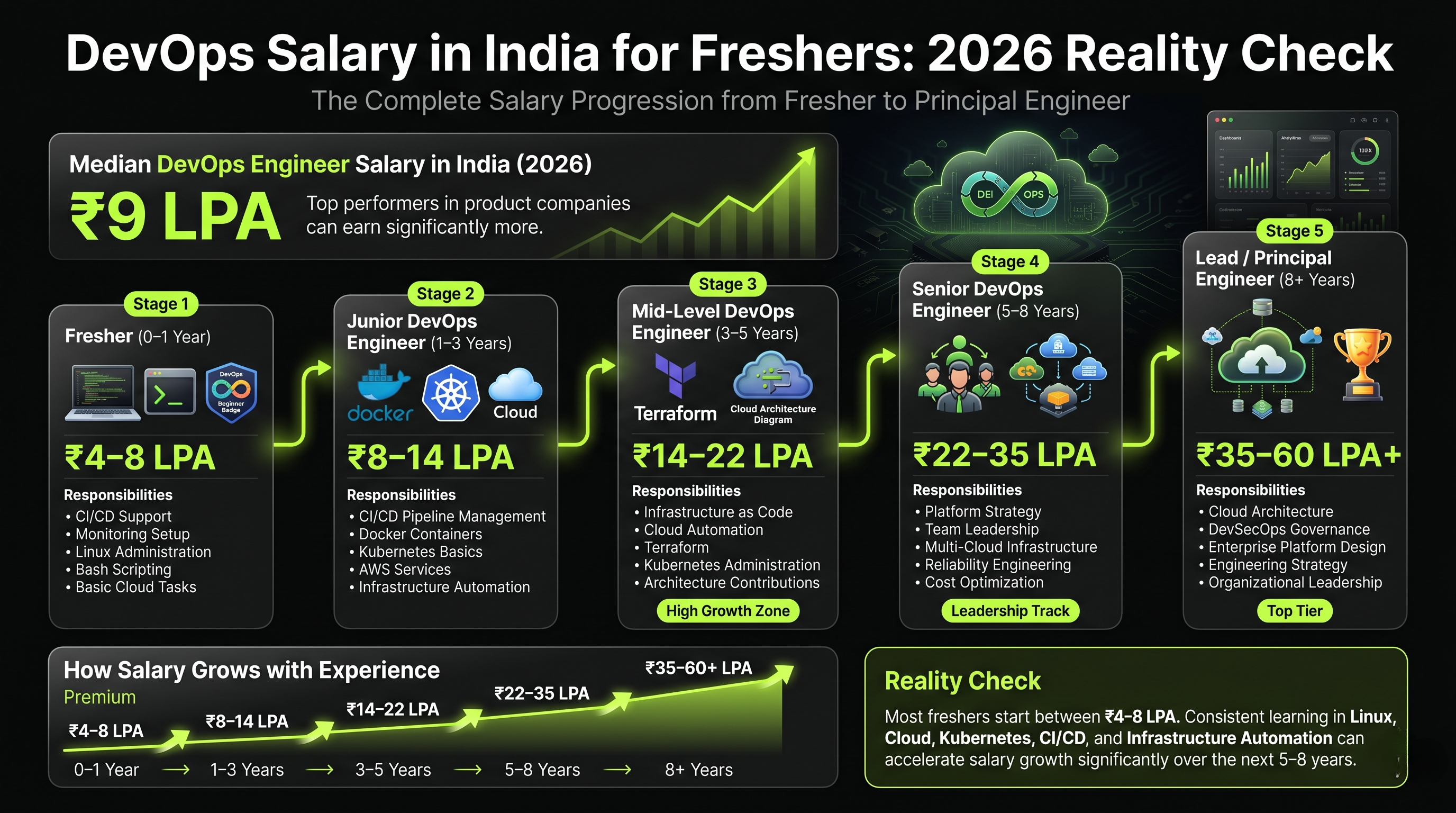
DevOps Engineer Salary Breakdown (India, 2026)
| Experience Level | Annual Package (LPA) | What You Typically Do |
|---|---|---|
| Fresher (0–1 yr) | ₹4–8 LPA | CI/CD support, monitoring setup, scripting |
| Junior (1–3 yrs) | ₹8–14 LPA | CI/CD pipeline management, Kubernetes basics |
| Mid-Level (3–5 yrs) | ₹14–22 LPA | Architecture decisions, IaC, cloud automation |
| Senior (5–8 yrs) | ₹22–35 LPA | Platform strategy, team leadership, multi-cloud |
| Lead / Principal (8+ yrs) | ₹35–60 LPA+ | Cloud architecture, DevSecOps governance |
✔ Median DevOps engineer salary in India (2026): ₹9 LPA, with top performers in product companies earning significantly more. (Source: Scaler)
What Pushes Fresher Salaries Higher?
Freshers who clear ₹6–8 LPA instead of the standard ₹4–5 LPA typically have:
- Cloud certification (AWS, Azure, or GCP)—adds a 20–30% salary bump
- Kubernetes knowledge (CKA)—premium tool, strong demand
- 3+ real project deployments on GitHub (not just local labs)
- Scripting ability—Python or Bash (not just knowing concepts)
- Internship experience—even 3 months changes the conversation
Salary by City for Freshers
| City | Fresher DevOps Salary |
|---|---|
| Bangalore | ₹5.5–₹8 LPA |
| Hyderabad | ₹5–7.5 LPA |
| Pune | ₹4.5–₹7 LPA |
| Chennai | ₹4.5–6.5 LPA |
| NCR | ₹5–7 LPA |
| Tier-2 Cities | ₹3.5–5 LPA |
Is DevOps Good for Freshers Specifically?
The Honest Challenge
DevOps is not an 'entry-level' field by traditional definition. It sits at the intersection of software development, Linux/Unix systems, cloud infrastructure, networking, and automation. That's a lot of surface area.
Unlike pure software development, where a fresher can contribute on day one with CRUD features, a DevOps fresher needs foundational competency across multiple domains before they're trusted with production systems. This is real. Don't let marketing brochures tell you otherwise.
Why Freshers Still Succeed in DevOps
- The tooling has matured: Docker, GitHub Actions, and Terraform have dramatically simplified the learning curve vs. 5 years ago
- Cloud providers have free tiers: AWS Free Tier, GCP's $300 credit, and Azure's student perks let freshers build real infrastructure for free
- Hiring demand outpaces supply: companies are training freshers internally because they can't find enough mid-level talent
- Structured programs work: freshers who complete project-based DevOps courses regularly land ₹5–8 LPA roles within 6–9 months
Who Has the Best Starting Position?
| Background | DevOps Readiness | What to Focus On First |
|---|---|---|
| CS/IT Graduate | High | Jump straight to Docker, CI/CD, and cloud |
| ECE/EEE Graduate | Medium | Start with Linux, networking, then cloud |
| Non-CS (BCA, BMS) | Medium | Python scripting + Linux fundamentals first |
| Career Switcher (IT Ops) | High | Leverage existing infra knowledge, add automation |
| Career Switcher (Non-IT) | Lower | Expect 9–12 months before first job |
Here at Nixace Technologies, we've noticed a clear pattern. The engineers who grow the fastest aren't usually the ones collecting the most certifications—they're the ones rolling up their sleeves and building things.
Whether they're tinkering with a self-hosted app, wiring up a GitHub Actions workflow, or wrestling with a Kubernetes deployment, actually getting in there and solving real problems is what builds a great engineer. At the end of the day, anyone can learn a new tool. What really sets top-tier DevOps professionals apart is that big-picture, systems-thinking mindset you only get by doing the work.
What Skills Do You Actually Need?
Here is what actually appears in job descriptions, not the curated list from a sales page.
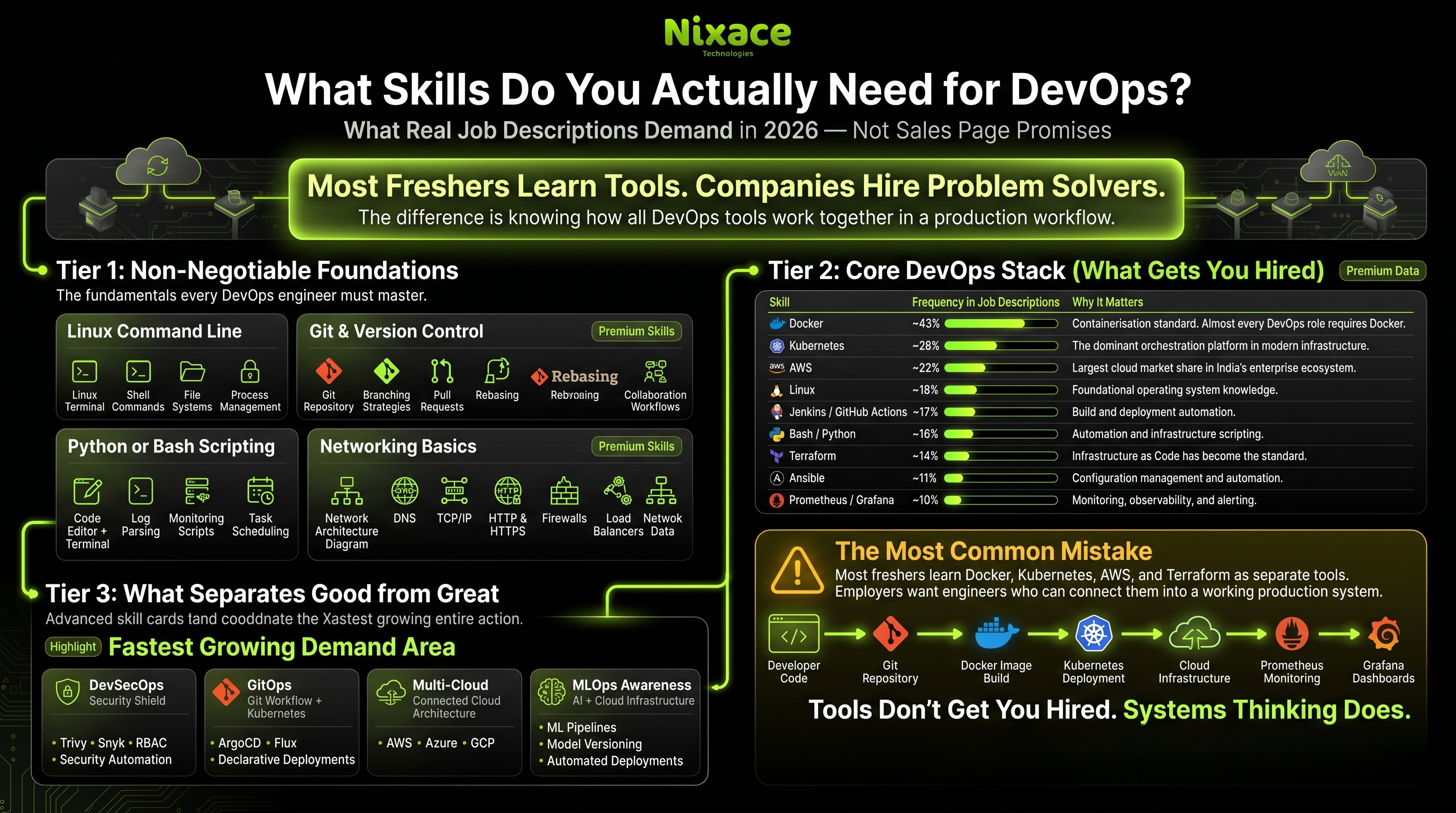
Tier 1: Non-Negotiable Foundations
- Linux Command Line—scripting, file systems, process management, permissions, shell
- Git & Version Control—branching strategies, rebasing, pull requests at scale
- Basic Python or Bash scripting—automation, parsing logs, system monitoring
- Networking basics—DNS, TCP/IP, HTTP/HTTPS, firewalls, load balancers
Tier 2: Core DevOps Stack (What Gets You Hired)
| Skill | Frequency in Job Descriptions | Why It Matters |
|---|---|---|
| Docker | ~43% | Containerisation standard: every DevOps role needs it |
| Kubernetes | ~28% | Orchestration standard: K8s is everywhere in 2026 |
| AWS | ~22% | Largest cloud market share in India's enterprise sector |
| Linux | ~18% | Foundational; assumed in most JDs |
| Jenkins / GitHub Actions | ~17% | CI/CD automation pipelines |
| Bash / Python | ~16% | Scripting for automation tasks |
| Terraform | ~14% | Infrastructure as Code, or IaC is now standard |
| Ansible | ~11% | Configuration management |
| Prometheus / Grafana | ~10% | Monitoring & observability |
Tier 3: What Separates Good from Great
- DevSecOps—security scanning in pipelines (Trivy, Snyk), RBAC management
- GitOps—ArgoCD, Flux for declarative deployments
- Multi-cloud—working across AWS, Azure, or GCP
- MLOps awareness—ML pipeline automation, model versioning (growing demand in 2026)
The Most Common Mistake: Most freshers learn tools in isolation. They finish a Docker course, then a Kubernetes course, then an AWS course—but never connect them into a working system. Real DevOps work means the following: code goes into Git, pipeline picks it up, and a Docker image is built and pushed to container registry. Kubernetes pulls it, deployed to the cloud, and monitored via Grafana. If you can't demonstrate that full chain in a real project, tool certificates alone won't get you far.
Is DevOps Dead Due to AI?
This is the question flooding Google searches in 2026. The 'DevOps is dead' narrative usually comes from viral articles written for engagement, not accuracy. Let's address it without hedging.
What AI is Actually Creating in DevOps
| New Role / Specialisation | What It Means |
|---|---|
| AIOps Engineer | Uses AI tools for predictive monitoring, automated incident response |
| Platform Engineer | Builds internal developer platforms (IDPs) that DevOps teams manage |
| MLOps Engineer | Manages ML pipelines, model versioning, and production model serving |
| LLMOps | Emerging: Infrastructure for large language model deployment |
| DevSecOps | Security automation baked into every pipeline stage |
Market Size: In 2026, the DevOps market in India is projected to reach USD 16.13 billion, growing at a CAGR of 21.76% through 2030. That is not a market in decline.
Verdict: If you're worried AI will replace DevOps engineers, focus instead on becoming the DevOps engineer who uses AI tools to be 5x more productive than those who don't. That's the actual career moat.
DevOps vs Other IT Paths: Where Does It Rank?
| Path | Fresher Starting Salary | 3-Year Potential | Learning Curve | Job Volume |
|---|---|---|---|---|
| DevOps Engineering | ₹4–8 LPA | ₹12–22 LPA | High | Very High |
| Full Stack Development | ₹5–9 LPA | ₹10–18 LPA | Medium-High | Very High |
| Data Science / ML | ₹7–12 LPA | ₹15–30 LPA | Very High | Medium |
| Cloud Architecture | ₹6–10 LPA | ₹16–28 LPA | High | High |
| Cybersecurity | ₹5–8 LPA | ₹12–22 LPA | High | Medium |
| Software Testing / QA | ₹4–6 LPA | ₹8–14 LPA | Low-Medium | High |
| Digital Marketing | ₹3.5–5 LPA | ₹8–14 LPA | Low | Very High |
DevOps stands out for a strong job volume combined with above-average starting salaries and a clear, steep growth trajectory. Unlike pure data science (which needs strong math), DevOps is accessible to CS and non-CS graduates willing to put in structured effort.
The Realistic DevOps Learning Roadmap for Indian Freshers
Here is a phase-by-phase plan designed for Indian freshers starting from near zero.
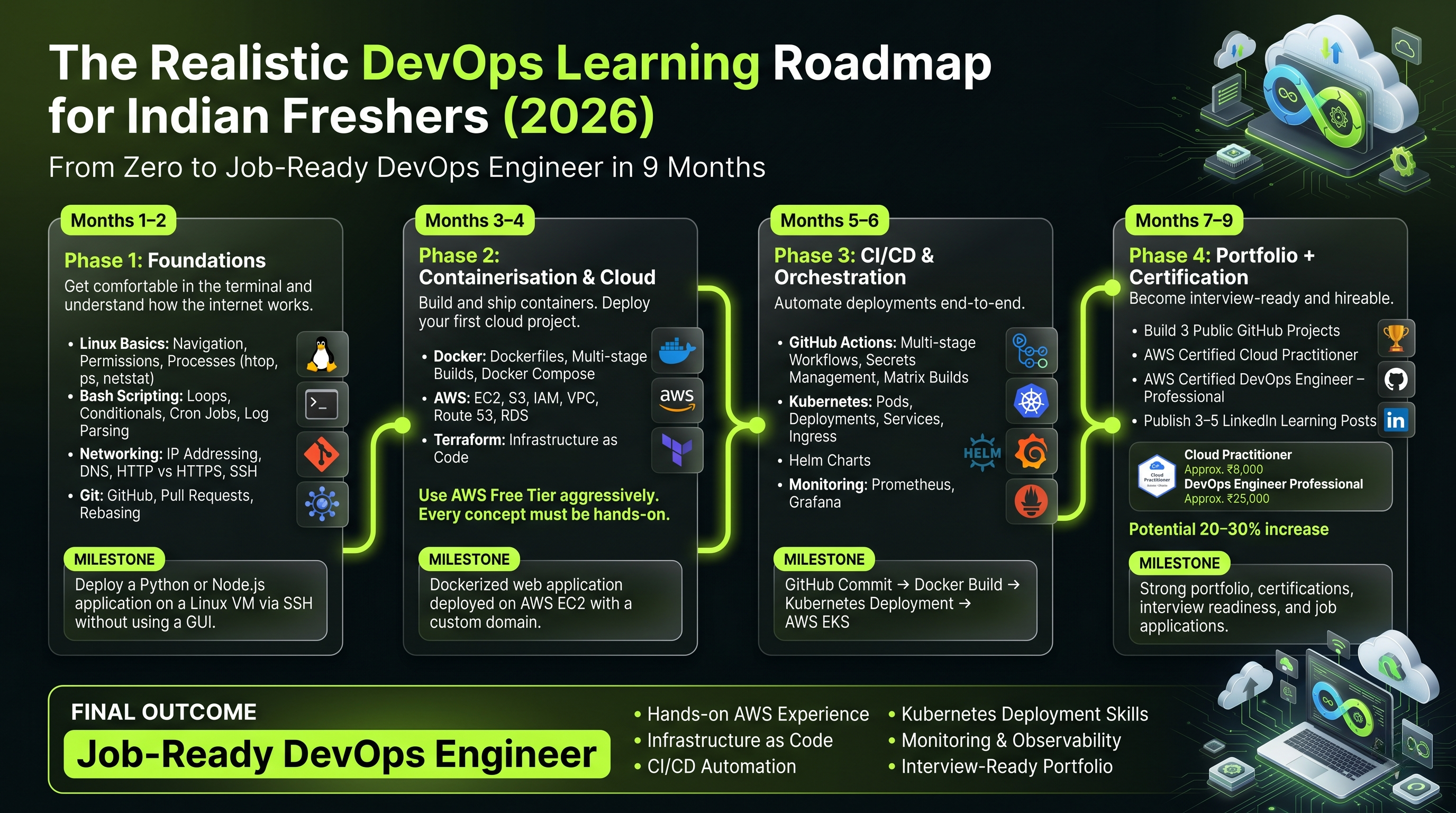
Phase 1: Foundations (Months 1–2)
Goal: Get comfortable in the terminal. Understand how the internet works.
- Linux basics: navigation, permissions, processes (htop, ps, netstat)
- Bash scripting: loops, conditionals, cron jobs, log parsing
- Networking: IP addressing, DNS, HTTP vs HTTPS, SSH
- Git: local workflows, GitHub, pull requests, rebasing
- Resources: Linux Journey (free), TryHackMe Linux rooms, GitHub's own Git tutorial
Milestone: Can deploy a simple Python/Node app on a Linux VM via SSH without a GUI.
Phase 2: Containerisation & Cloud (Months 3–4)
Goal: Build and ship containers. Get your first cloud project live.
- Docker: Dockerfiles, multi-stage builds, Docker Compose
- AWS (start here): EC2, S3, IAM, VPC, Route 53, RDS basics
- AWS Free Tier—use it aggressively. Every concept should be hands-on.
- Begin Terraform: provision a simple AWS infra via code, not console clicks
✔ Milestone: A Dockerized web app deployed on AWS EC2, accessible via custom domain.
Phase 3: CI/CD & Orchestration (Months 5–6)
Goal: Automate the deployment pipeline end-to-end.
- GitHub Actions: multi-stage workflows, secrets management, matrix builds
- Kubernetes: local cluster via Minikube or Kind, pods, deployments, services, ingress
- Helm charts: package and deploy K8s applications
- Monitoring: Prometheus + Grafana on a live K8s cluster
Milestone: Full CI/CD pipeline from GitHub commit → Docker image build → K8s deployment on AWS EKS.
Phase 4: Portfolio + Certification (Months 7–9)
Goal: Make yourself hireable on paper and in interviews.
- Build 3 public GitHub projects that demonstrate the full pipeline
- Pursue AWS Certified Cloud Practitioner (easiest entry, costs ~₹8,000)
- Target AWS Certified DevOps Engineer—Professional eventually (₹25,000 exam fee, 20–30% salary bump)
- Write 3–5 LinkedIn posts showing your builds, learnings, and what broke (and why)
Milestone: First interview call from Naukri or LinkedIn within 60 days of completing Phase 4.
Pro Tips From Real Hiring Experience
- Don't collect certifications before projects. A CKA with zero real clusters is a red flag.
- One working GitHub project beats five incomplete ones. Finish things.
- Join the DevOps community: Twitter/X DevOps community, CNCF India Slack, and local cloud meetups.
- Apply before you feel 'ready.' Most freshers wait 3 extra months unnecessarily.
- Learn to explain 'what broke and how you fixed it.' That's the interview answer most freshers can't give.
What Top Companies Are Actually Hiring For
Analysis of job descriptions across Naukri and LinkedIn for fresher/junior DevOps roles in India.
| Skill | Frequency in JDs | Priority Level |
|---|---|---|
| Docker | ~43% | Critical |
| Kubernetes | ~28% | Critical |
| AWS | ~22% | Critical |
| Linux | ~18% | Critical |
| Jenkins/GitHub Actions | ~17% | High |
| Bash / Python | ~16% | High |
| Terraform | ~14% | High |
| Ansible | ~11% | Medium |
| Monitoring (Prometheus/Grafana) | ~10% | Medium |
Most companies listing '0–2 years experience' for DevOps roles expect basic Docker knowledge, some CI/CD exposure (personal projects count), familiarity with at least one cloud platform, and Linux comfort above 'basic.' They are NOT expecting you to have managed production Kubernetes clusters with 10,000 pods.
Honest Pros and Cons of Choosing DevOps
| PROS | CONS |
|---|---|
| High and growing demand (250,000+ openings in India, 20–30% YoY growth) | Steep initial learning curve—multiple domains simultaneously |
| Strong salary ceiling (₹35–60 LPA+ at senior level) | Certification costs—serious certs cost ₹25,000–₹40,000+ each |
| Career diversity: pivot into cloud, SRE, platform engineering, DevSecOps | Not a quick-win path: 6–9 months minimum to become hireable |
| Remote-friendly: 30% YoY growth in remote DevOps roles | Requires constant upskilling; the tooling landscape shifts regularly |
| AI tailwind: AIOps, MLOps, LLMOps are derivatives of DevOps | On-call responsibilities—senior roles often mean weekend incidents |
| Cloud adoption is irreversible—every company needs infra management | Hiring concentration for most good roles in Tier-1 cities |
Frequently Asked Questions
Is DevOps a good career for freshers in India?
Yes, but with a caveat: DevOps requires foundational knowledge in Linux, networking, and scripting before you can be productive in a real role. Freshers who invest 6–9 months in structured, project-heavy learning regularly land ₹4–8 LPA as their first package—higher than most entry-level IT roles.
What is the scope of DevOps in India in 2026?
The scope is strong and growing. India has over 250,000 active DevOps job openings, the market is expanding at a CAGR of 21.76% through 2030, and demand exceeds domestic supply.
Is DevOps dead due to AI?
No. AI is automating specific DevOps tasks, not replacing DevOps roles. It is creating new specializations: AIOps, MLOps, LLMOps, and platform engineering, that require DevOps foundations. Engineers who combine DevOps skills with AI tool proficiency are in higher demand than ever.
What is the fresher salary for a DevOps engineer in India?
Freshers typically start between ₹4 LPA and ₹8 LPA depending on skills, location, and company type. Freshers with cloud certifications (AWS CCP or higher) and real project deployments can command ₹6–8 LPA in Tier-1 cities.
Which cloud platform should a fresher learn first for DevOps?
Start with AWS. It holds the largest market share in India's enterprise sector, has the most active job demand, and the free tier is generous enough to build meaningful projects without spending money.
How long does it take to become job-ready in DevOps?
For a CS/IT graduate with basic programming knowledge: 6–9 months of focused, hands-on practice. For non-CS backgrounds or career switchers: 9–14 months. These timelines assume structured learning with real project builds, not passive video consumption.
What certifications are worth it for DevOps freshers in India?
| Certification | Exam Cost | ROI | Priority |
|---|---|---|---|
| AWS Certified Cloud Practitioner | ~₹8,000 | Strong foundation | Tier 1: Start here |
| AWS Certified DevOps Engineer - Professional | ~₹25,000 | 20–30% salary bump | Tier 2 – High ROI |
| Certified Kubernetes Administrator (CKA) | ~₹33,000 | Strong K8s demand | Tier 2 – High ROI |
| HashiCorp Terraform Associate | ~₹7,000 | Useful, not mandatory | Tier 3 – Optional |
Important: Certifications without practical project experience are a red flag to experienced hiring managers. Skills and projects first, then certifications.
What is the DevOps future scope in India for the next 5 years?
Extremely positive. By 2030, India's DevOps market is projected to grow from USD 16 billion to USD 43 billion (21.76% CAGR). The rise of GenAI, MLOps, and cloud-native architectures ensures DevOps remains central to every tech organization's delivery model.
Can I learn DevOps without a coding background?
You need scripting proficiency (Bash or Python), not full software development skill. If you can write a script that reads a config file, filters logs, and sends an alert, that's sufficient for most entry-level roles. The bar is 'automation-aware,' not 'software developer.'
Is a 6-month bootcamp enough to get a DevOps job?
Only if the bootcamp is genuinely project-heavy (minimum 5–10 real deployments) and includes live cloud environment access. A bootcamp that's 80% video lectures and 20% labs will not produce job-ready candidates. Ask for alumni outcomes before enrolling anywhere.
Conclusion and Next Steps
Here's the straight answer for Indian freshers in 2026:
DevOps is worth learning. The demand is real. The salaries are competitive. The growth path is clear. And the AI disruption narrative is, at this point, more noise than signal.
But 'worth learning' doesn't mean 'easy' or 'fast.' The freshers who succeed in DevOps are those who:
- Build real things in cloud environments—not just complete courses
- Understand systems, not just individual tools
- Document their learning publicly (GitHub, LinkedIn)
- Apply before feeling fully ready
- Ask for help from communities that have walked this path
If you're looking for a path that offers both strong job security and an increasingly important role as AI transforms software delivery, DevOps is one of the best bets in India's IT landscape right now.